Versions
- 2020-10-21 (2)
- 2020-03-24 (1)
Keywords
neurokinin-1 receptor antagonist
hyaluronic acid/carboxymethylcellulose Adherencias peritoneales
antagonista de Receptor 1 de neurokinina
ácido hialurónico/carboximetilcelulosa
How to Cite
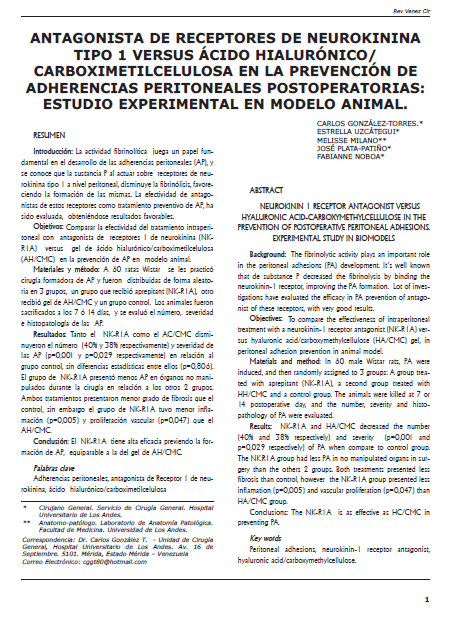
Abstract
Background: The fibrinolytic activity plays an important role in the peritoneal adhesions (PA) development. It´s well known that de substance P decreased the fibrinolysis by binding the neurokinin-1 receptor, improving the PA formation. Lot of investigations have evaluated the efficacy in PA prevention of antagonist of these receptors, with very good results. Objectives: To compare the effectiveness of intraperitoneal
treatment with a neurokinin-1 receptor antagonist (Nk-R1A) versus hyaluronic acid/carboxymethylcellulose (HA/CMC) gel, in peritoneal adhesion prevention in animal model. Materials and method: In 60 male Wistar rats, PA were induced, and then randomly assigned to 3 groups: A group treated with aprepitant (Nk-R1A), a second group treated with HH/CMC and a control group. The animals were killed at 7 or
14 postoperative day, and the number, severity and histopathology of PA were evaluated. Results: Nk-R1A and HA/CMC decreased the number
(40% and 38% respectively) and severity (p=0,001 and p=0,029 respectively) of PA when compare to control group. The Nk.R1A group had less PA in no manipulated organs in surgery than the others 2 groups. Both treatments presented less fibrosis than control, however the Nk-R1A group presented less inflamation (p=0,005) and vascular proliferation (p=0,047) than HA/CMC group. Conclusions: The Nk-R1A is as effective as HC/CMC in preventing PA.

This work is licensed under a Creative Commons Attribution-NonCommercial 4.0 International License.
Copyright (c) 2020 REVISTA VENEZOLANA DE CIRUGÍA