Keywords
How to Cite
Abstract
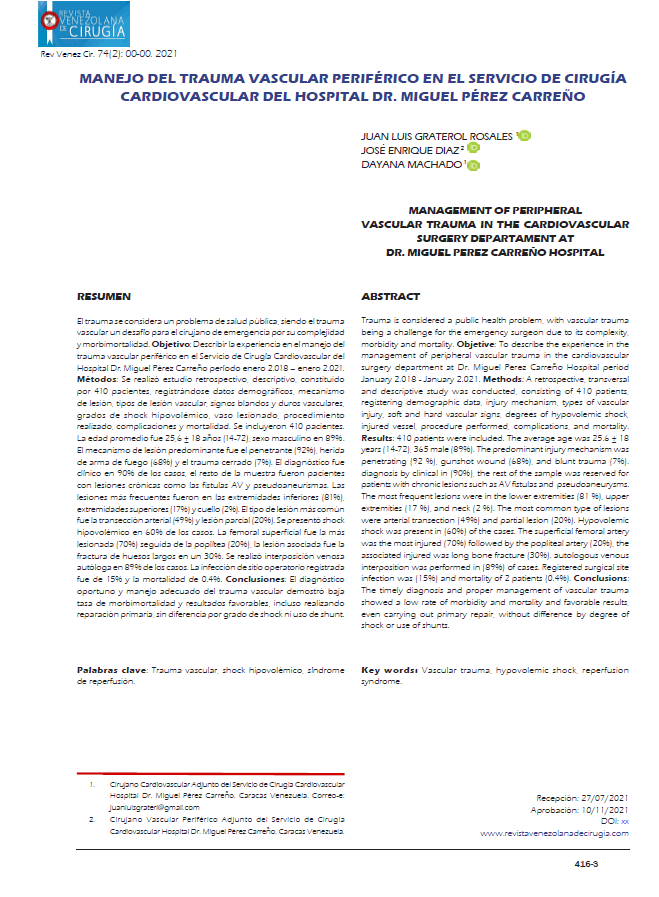
ABSTRACT The trauma is considered a health problem public , with the vascular trauma A challenge for emergency surgeon s or complexity and morbidity and mortality.OBJETIVE Describe the experience in the management of peripheral vascular trauma in the cardiovascular surgery service at Dr.Miguel Perez Carreño Hospital period January 2.018 - January 2.021.METHODS It was conducted prospective, descriptive and transversal. Made up of 410 patients , recording demographic data, injury mechanism, vascular soft and hard signs, degrees of hypovolemic shock, injured vessel, procedure performed, complications, and mortality.RESULTS 410 patients were included. The average age was 25.6 ± 18 years (14-72). 365 male (89%). The predominant injury mechanism was penetrating (92 %),the most frequent being the firearm (68%) and (7%) blunt trauma by rolling. The diagnosis was clinical in (90%), most affected site of injury and lower extremities ( 81 %) , Upper extremities (17 %) , Neck (2) % , arterial transection as the most common type of injury in (49%) ) and lesion part in a (20%), hypovolemic shock in (60%), the arterial superficial femoral being more injured in (70%)followed by the popliteal retrogenicular (20%).The procedure to performed venous interposition autologous (89%).Surgical site infection in (15%).Total mortality of 2 patients (0.4%).CONCLUSIONS The timely diagnosis and proper management of vascular trauma undoubtedly showed a low rate of morbidity and mortality and favorable results, even performing primary repair in 100% of cases without differing by degree of shock, nor use of shunt.

This work is licensed under a Creative Commons Attribution-NonCommercial 4.0 International License.
Copyright (c) 2021 REVISTA VENEZOLANA DE CIRUGÍA