Keywords
gastrectomía vertical laparoscópica
manga gástrica
cirugía bariátrica
cirugía metabólica
diabetes 2
How to Cite
Abstract
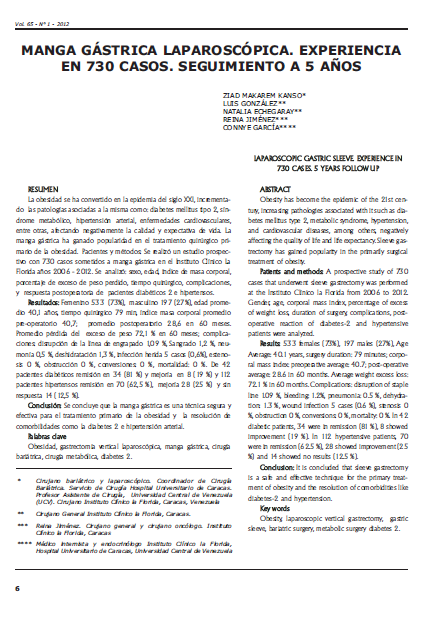
Obesity has become the epidemic of the 21st century, increasing pathologies associated with it such as diabetes mellitus type 2, metabolic syndrome, hypertension, and cardiovascular diseases, among others, negatively affecting the quality of life and life expectancy. Sleeve gastrectomy has gained popularity in the primarily surgical treatment of obesity. Patients and methods: A prospective study of 730
cases that underwent sleeve gastrectomy was performed at the Instituto Clínico la Florida from 2006 to 2012. Gender, age, corporal mass index, percentage of excess of weight loss, duration of surgery, complications, postoperative reaction of diabetes-2 and hypertensive
patients were analyzed. Results: 533 females (73%), 197 males (27%), Age Average: 40.1 years, surgery duration: 79 minutes; corporal
mass index: preoperative average: 40.7; post-operative average: 28.6 in 60 months. Average weight excess loss: 72.1 % in 60 months. Complications: disruption of staple line 1.09 %, bleeding: 1.2%, pneumonia: 0.5 %, dehydration: 1.3 %, wound infection 5 cases (0.6 %), stenosis 0 %, obstruction 0 %, conversions: 0 %, mortality: 0 %. In 42 diabetic patients, 34 were in remission (81 %), 8 showed improvement (19 %). In 112 hypertensive patients, 70 were in remission (62.5 %), 28 showed improvement (25 %) and 14 showed no results (12.5 %). Conclusion: It is concluded that sleeve gastrectomy is a safe and effective technique for the primary treatment of obesity and the resolution of comorbidities like diabetes-2 and hypertension.

This work is licensed under a Creative Commons Attribution-NonCommercial 4.0 International License.
Copyright (c) 2020 REVISTA VENEZOLANA DE CIRUGÍA